

🧶 The Run of Calling Threads a Failure
🪡 Reflecting on those Graphs, showing less Interest in Threads 🪡 Unpacking the "Dear Algorithm" Conversations 🪡


Berlin marks 12 PM | New York greets 6 AM | LA embraces 3 AM
Greetings from Daniel, savoring the serenity of this week, an apt backdrop for today's topic. Opinions vary: some sense tranquility, others perceive a ghost town. We'll explore the public's reaction to the dwindling use of Threads.
A warm welcome to the 1 in 4 newcomers reading their first issue of my pop-up newsletter. My initiative to personally greet the first 100 subscribers is nearing its completion - 80 dispatched, 22 more than two days ago. Though mere figures, I cherish this interaction. Also, heartfelt thanks for your positive responses to “The Measurement of the Microblogosphere” deep dive.
What's Inside This Issue: We introduce "Community Knitting," a segment dedicated to your inquiries about Threads and decentralized social media. Plus, a treat: Discover a method to create a virtual snowfall, inspired by Threads.
The Run of Calling Threads a Failure
Two prevailing narratives have emerged in the discourse around Threads: its potential to rival X/Twitter as a killer app, and the growing perception of Threads transforming into a ghost town due to user disinterest. While the first point awaits more concrete data and settled debates, it's crucial to examine the validity of the latter claim.
The lifecycle of digital intrigue follows a predictable pattern: novelty breeds interest, sustained by compelling narratives. Initially, Meta propelled Threads into the limelight with a remarkable story. The platform boasted the fastest user growth in the company's history, eclipsing even ChatGPT's record by amassing 100 million users in an unprecedented timeframe. This achievement, a text-based social network surpassing the AI sensation of the year, was palpable in the enthusiastic coverage. However, once Meta ceased updating this narrative with fresh data, interest waned, necessitating a new angle.
In the absence of official updates, observers turned to alternative sources for insights: app download rankings, Android usage statistics, and various business intelligence reports, including those of questionable credibility.
Then came the pivotal moment: graphical representations began depicting a downturn in Threads' user engagement. Were these indicators of a long-term decline or merely temporary fluctuations? These could have been the questions driving the discourse. However, a consensus quickly formed around a singular interpretation: Threads was losing its appeal, user activity was dwindling, and the platform was effectively 'dead.' This narrative, marked by a distinct undertone of schadenfreude, dominated media coverage and user discussions. It was the beginning of what I call “The Run of Calling Threads a Fail”.
As we delve deeper into the data, our aim is to offer a nuanced analysis of these trends and their potential implications for Threads' future.
The Rise
Here is Exhibit A:
Threads Tops 100 Million Users In Five Days

App / Reaching 100 Million Active Users

1. Threads 0.2
2. ChatGPT 2
3. TikTok 9
4. Instagram 30
5. Pinterest 41
6. Spotify 55
7. Telegram 61
8. Uber 70
9. Google Translate 78
Of course, the reason for this rapid growth was Meta’s strategic decision to connect each Threads account with the user’s Instagram account 🤝.
The question of whether this is a reasonable use of Meta’s market power is yet to be discussed 🤔. But this decision contributed to some notable developments, which were very likely anticipated by Meta:
A rocket start 🚀 for sign-ups due to the prominent visibility on Instagram to a more than a billion large desired target group (more Zeitgeist interested, less News and Politics like X/Twitter)
Relying on the existing infrastructure and a small team kept the budget and therefore the financial risk low 💸
New users started with a personalized social graph 👥. They didn’t have to select one by one whom to follow. The feeds were filled with known names
A potential success story for the next earning calls 📈
An opportunity to test out the new platform rules in Europe 🇪🇺. It seems better to negotiate with EU regulators on a potential forbidden mechanism, that is attached to a new product, instead of getting into a fight over a mechanism of its money makers 💰.
Reading this list, we get a glimpse of why it was worth it for Meta to start without the EU 🌍.
The Fall
Here is Exhibit B:
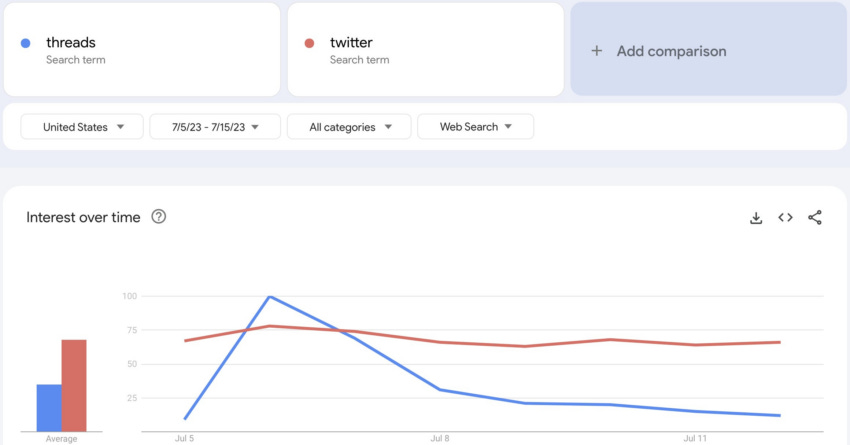
“Fastest Flop in History” - “Is Threads already falling apart?” 📉 These are just two headlines showcasing a screenshot of Google Trends, featuring an impressive decline curve for Threads, while X/Twitter’s remains steady. Their interpretation implies that googling a social network correlates with its usage.
Why do people search for a social network? 🤔
They are too lazy to type or don’t know the URL to log in 🌐
They heard about it and want to learn more about it 🕵️♂️
The network made headlines itself 📰
They want to download the app 📲
A person’s posting was quoted in the news 🗞️
They want to check on a certain profile, even if they don’t have an account 🔍
Only the first and fourth reasons lead directly to usage. The other reasons may eventually lead a minor percentage into active usage. All Reasons are applicable for X/Twitter. 1-4 for Threads.
Taking a closer look at the timeframe of this chart is useful: It covers only the launch week of Threads. So, this isn’t about a long-term trend. The press coverage of the start gave people good reasons to search for Threads - very likely due to one of the first four reasons. This interest accumulated in a spike, which was for a day 25% higher than the interest in X/Twitter 🚀.
And since there was no web version of Threads at that time, users didn’t need to return to Google to continue using Threads. They just had to open their app 📱.
While search interest might indicate a trend in usage, to be sure, we need to consider all other reasons that might weigh in on this interest. This is particularly true for Threads’ launch week.
Here is Exhibit C:
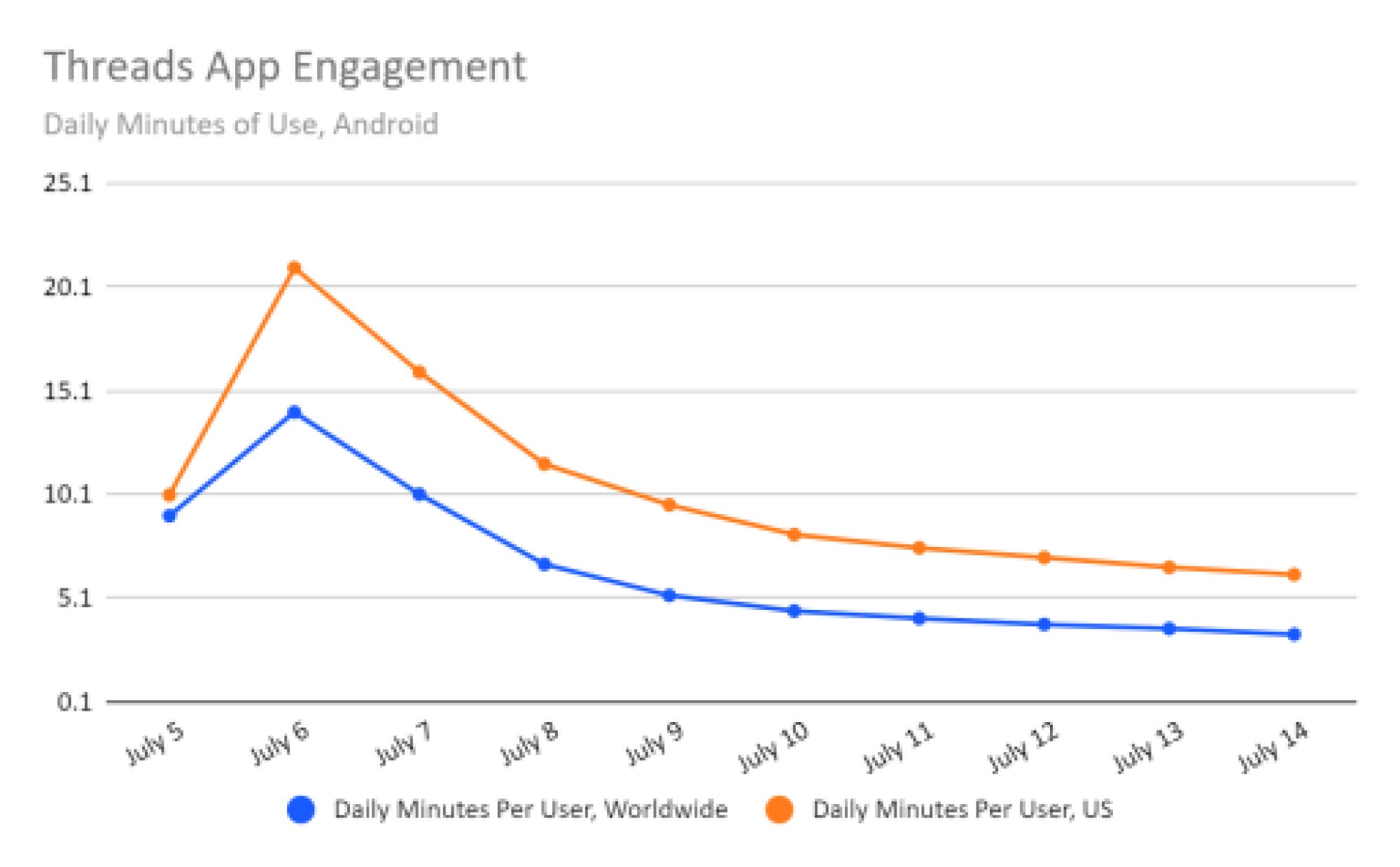
These curves show a decline in usage time by Android users 📉. Some viewers might envision these curves continuing their descent until they reach a disheartening zero. But is this enough to declare it a failure? ❓
What do people do on a new social app? 🌐
Initially, it's new and exciting. Users spend time exploring every nook and cranny of the network 🕵️♂️.
As the initial excitement wanes, they need a compelling reason to stay. They search for their personal usage case that offers some kind of value 🤔.
Users might be willing to give the app a chance for a while, albeit likely spending less time than on the first day ⌛.
This pattern of usage is reflected in the curves. Since the novelty of being a new social app has long faded for most users on X/Twitter, they have settled into their daily routines 🔄.
How might Threads' daily usage evolve over time? Perhaps we can glean insights from a similar event in the past 🧐.
A Quick Lesson from History 📜
I remember my first day on Twitter. I posted some tweets, looked around, and then closed the app... for a long time. It took me six months to discover a relevant use and become a regular user 🕓.
As for Twitter itself, it took even longer to find a use case that attracted the masses. Originally a side project of a company focused on podcasting solutions, Twitter was intended as a tool for updating friends on one's activities. It took years for Twitter to evolve into the world's real-time communication platform 🌍.
Initial Launch and Slow Start (2006-2007)
Founded in March 2006, Twitter was a project within Odeo, a podcasting company, intended for short, 140-character messages 🐦.
Public launch in July 2006: The platform didn't gain immediate popularity, appealing mostly to tech enthusiasts and early adopters 🚀.
SXSW 2007: A Turning Point
At the SXSW Interactive conference in March 2007, Twitter's usage spiked as they displayed live tweets around the conference, capturing attendees' attention 📈.
Factors Leading to Wider Adoption (2008-2009)
Celebrity Adoption: Twitter's popularity surged as celebrities joined and their fans followed 🌟.
Smartphone Integration: The advent of smartphones made Twitter more accessible 📱.
Media Coverage: Twitter garnered media attention, especially during events like the Hudson River plane landing in 2009 📰.
Growth and Establishment (2010-2012)
International Events: Twitter's role in the Arab Spring highlighted its significance in real-time communication 🌐.
Product Evolution: Features like hashtags, retweets, and @mentions shaped user interactions ✨.
Mobile App Development: Improvements in the mobile app enhanced user experience 📲.
What History tells us:
It took 3-4 years for Twitter to be known as a Real-Time Information Network, a shift driven by user behavior and newsworthy events 🕒.
Imagine the headlines if Twitter's early usage stats were scrutinized as Threads' are now 🤔.
* * *
As for Threads, two major takeaways:
Even though Meta sets the framework, ultimately, user behavior will define the platform's success 🛠️.
Discovering the ultimate use case of a platform can take time ⏳.
To declare Threads a failure while Meta is still adapting might be premature. The future is still unwritten 🌟.
Community Knitting (1): Decoding the “Dear Algorithm” Posts 🧵
Over Christmas, many Threads users seemed to embrace follower trolling as their new posting style. Others reposted with enthusiasm but without verification - a behavior we often see with fake news victims. This naivety about social media platforms and their algorithms became apparent with the “Press Long” postings and “Dear Algorithm, please connect me with” posts. Let's unravel the mystery behind these “Dear Algorithm” posts.
The phrase “Dear Algorithm, please connect me with” is often followed by a wishlist of topics people want to see more of.
Is it weird to talk to an algorithm instead of your followers? Socially, perhaps 🤔.
But technically? 🖥️
One of the biggest misconceptions about social media is the nature of their algorithms. Misunderstanding led to secrecy, which in turn became mythologized. This mystique led people to personify algorithms, and their posting behavior turned into a kind of cargo cult.
It’s surprising how many people claim ignorance about social media algorithms, especially when Meta has made significant efforts to explain theirs on help pages and through campaigns in recent years. The news feed algorithm, introduced by Facebook in 2006, was openly discussed in their blogs, detailing changes and the rationale behind them.
Here’s Rule #3 from the small multiplication table of social media:

"Don’t post for the Algorithm, post for your Audience" 👥.
Your audience is actually a potent influencer of algorithms. Typical social media algorithms are governed by three categories of rules:
Rules reflecting users' current media consumption and communication behavior - encouraging longer, more intensive engagement 🔄.
Rules countering attempts to trick the algorithm (like clickbait) 🚫.
Rules supporting the network’s KPIs for business, public affairs, or other strategic reasons 📊.
User behavior heavily influences these algorithms. For example, why do photo posts typically have greater reach than link posts? It’s not just algorithmic bias; it's how people engage with content. Users tend to interact more with photos - stopping, clicking, liking - than with link posts, where they might click only one or two articles. This interaction pattern dictates which posts get more visibility in the feed.
My own viral successes with link posts disprove the notion that algorithms inherently work against such content. It’s all about offering relevant content to your audience. This is also why general news site accounts tend to have lower engagement rates compared to those focusing on niche topics. But that’s a story for another time.
As for users adopting the “Dear Algorithm” pattern, their intentions are commendable: seeking more engaging content and discovering like-minded people. The good news is that you can effectively train Threads to enhance your feed experience 👍.
How to Teach Threads to Show Less of Certain Topics:
- Press '...' in the upper right corner of a posting 🚫.

- Select 'Mute' 🔇.

- You won't see postings from that author immediately, and if you repeat this with postings of the same topic, you'll gradually see fewer of those in your feeds over time.
How to Teach Threads to Show More of Certain Topics:
- If you encounter a posting about a topic you're interested in, engage with it. Like it, share it, or comment on it - commenting is one of the strongest signals you can give 👍.

- Repeat this with postings on similar topics to reinforce your interest 🔁.

- You'll start seeing more postings like these in your "Following" and "For You" feeds 📈.
There's even a way to publish a post that can connect you with new people who share your interests. For this to work, we rely on your followers rather than the algorithm. Here's an example:
Hey Followers, I need your help! I'm missing some topics I love in my feeds. Can you recommend some Threads accounts that cover them?

I'm interested in:

Smart Threads observations 🧠
Discussing Podcast Trends 🎙️
Posting Breakfast recipes 🍳

Any accounts come to mind? Thanks a ton!! #followerpower ✨
What's your most important question about Threads or decentralized social media? Let me know, and I'll add it to our coverage radar. We'll stitch together information and thoughts into a solid answer and feature it in our Community Knitting series.
Check out all the questions in our Digital Newsroom, vote for them, add yours, or use the comment section below on the web. Via email, just hit the reply button.
Community Knitting (2): How Can I Create a Snow Effect Like Threads on My Homepage? ❄️
If you're looking to add a magical snowfall effect to your webpage, similar to the one on Threads, there's a service for that! Embed.im offers a beautiful, possibly even more enchanting, snowfall integration for any webpage 🌨️.
To add this snowy magic to your homepage, simply copy and paste the following code into the source code of your document:
<script src="https://app.embed.im/snow.js" defer></script>🔔 For readers in the EU: Since this script loads data from a third-party server, you should obtain your visitors' consent before activating the script to comply with GDPR regulations 🇪🇺.
What’s new?
The year of social media soul-searching: Twitter dies, X and Threads are born and AI gets personal (AP)Coming up
It's the end of the year, a perfect time to do a first evaluation of how Threads is faring in its quest to become an X/Twitter killer app 🎯. Also, get ready for some handy tips and strategies if you're looking to bring some organization to your social media activities in preparation for the new year 📅.
All our upcoming stories are featured in the new Style & Stitches Digital Newsroom. If you're eager to see your favorites, go ahead and cast your votes ✅.
Stitch on,
Daniel 🧵
If you enjoyed this newsletter, I'd be thrilled if you could give me a shoutout to your social media besties!
If this newsletter was forwarded to you, thanks for reading! Why not enjoy the convenience of getting the next issue delivered directly to your inbox?
Crafting term of the day: Patchwork — this is the craft of sewing together smaller pieces of fabric (patches) to form a larger, patterned piece.
From Europe with <3